
Who scored the first goal at Old Trafford?
Regarded as one of the wonders of the Edwardian age, this iconic stadium opened its gates nearly 116 years ago, just outside the city boundary of Manchester. Old Trafford was envisioned as a sporting cathedral far superior to the muddy pitches of the era.
Since its official opening in 1910, the "Theater of Dreams" has stood as a silent witness to the evolution of modern football. Over the past century, it has hosted thousands of matches, including World Cup fixtures, European Cup finals, and countless domestic battles. Estimations suggest that 10.000 of goals have been celebrated within these stands, creating a legacy that few stadiums worldwide can rival.
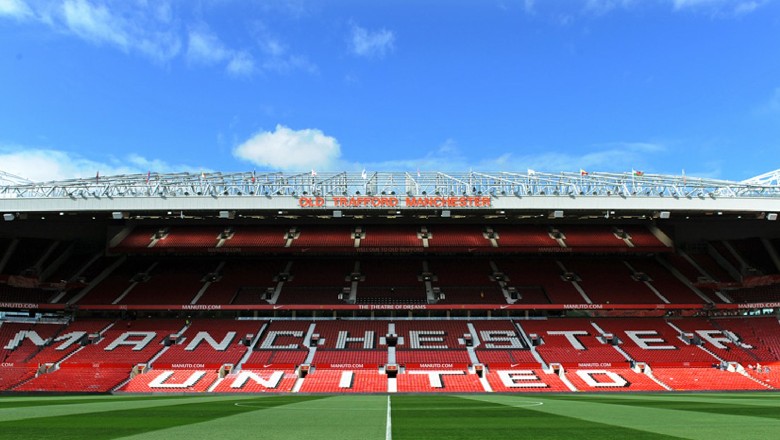
It holds the record for the highest attendance in an English League game and remains the largest club stadium in the United Kingdom. Writing a chapter of history on this grass is a rare privilege, as not every talented player gets the opportunity to perform on such a grand stage.
Consequently, being the individual who inaugurated the scoring at this venue is perhaps the ultimate "dream" in a footballer's life. Do you remember the pioneer who claimed this honor? Let us join Spbolivescore as we delve into the archives to answer the historic question: Who scored the first goal at Old Trafford?
Who scored the first goal at Old Trafford?
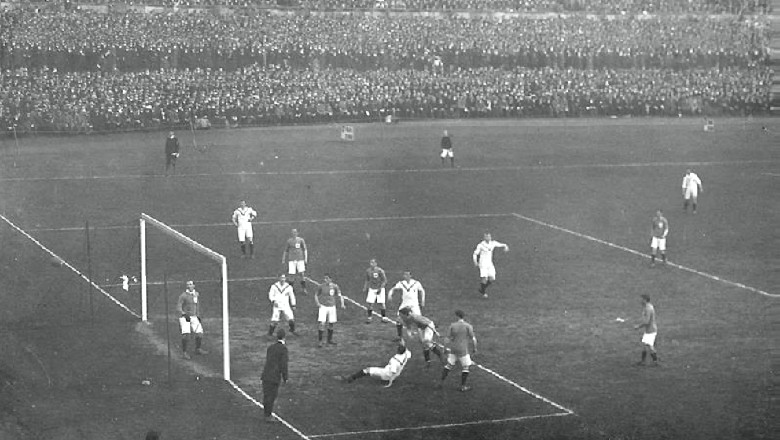
This name takes us back to a cold Saturday afternoon on February 19, 1910. The inaugural match at the newly built stadium featured a fierce clash between the home side, Man United, and their rivals, Liverpool. In front of a staggering crowd of approximately 45,000 to 50,000 fans, who overwhelmed the city’s tramways and arrived in everything from taxis to coal lorries, the deadlock was broken in the opening minutes. The man who secured his place in immortality was Alexander "Sandy" Turnbull.
The goal was a masterpiece of Edwardian bravery. Following a free kick taken by United’s Duckworth from near the right-hand corner flag, the ball was expertly dropped into the heart of the penalty area.
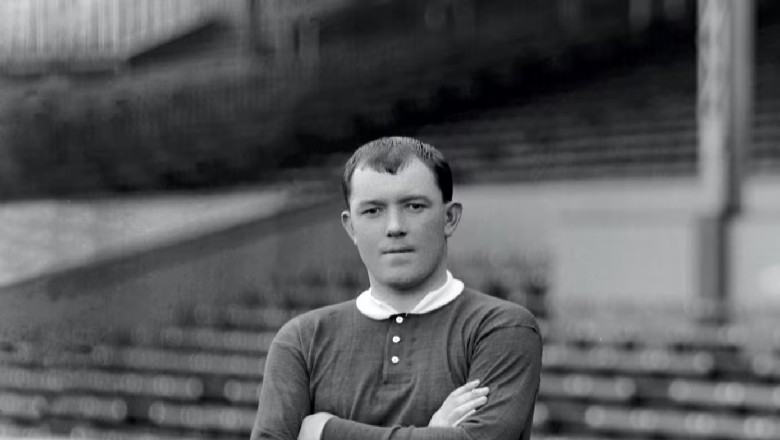
Turnbull, a stocky and powerful figure wearing the red jersey with Number 10, charged into the box with his head lowered. Despite the ball being only a foot or two from the ground, he met it with a trademark diving header, driving it hard into the back of the net. The stadium erupted as fans waved red-and-white umbrellas in celebration.
However, the match itself was a rollercoaster of emotions. Turnbull provided the dream start, the game eventually ended in a 3-4 defeat for Man United. Alongside Turnbull’s opener, Thomas Homer and George Wall also scored for the Reds. On the opposing side, Liverpool’s Arthur Goddard (2), Jimmy Stewart, and Kenneth Campbell secured the win for the visitors.
Despite the loss, the 1909/11 period remained a golden era for United, they had won the league title in 1908 and the FA Cup in 1909, and they would go on to win the First Division title again in 1911.
Born in Hurlford, Ayrshire, Scotland, in 1884, Alexander Turnbull was the son of a coal miner. His journey to stardom began in the rugged local leagues of Scotland before he moved south to join Manchester City in 1902. At City, he became a hero, scoring the winning goal to help them secure the 1904 FA Cup, the first major trophy in their history. However, his career took a dramatic turn following a financial scandal involving illegal payments at City, which led to his transfer to Man United in 1906 for a reported fee of £350.
At United, "Sandy" became a cornerstone of the club’s first great team. He made 247 appearances and scored 101 goals, a tally that currently places him as the 19th highest scorer in the club's history, just behind Wayne Rooney, who eventually inherited his iconic Number 10 shirt.
Turnbull was described by contemporary observers as a "powerful, square-headed" player with a relentless work ethic and a "durable head" that feared no challenge. Beyond his technical skills, Turnbull was a polarizing figure.
He was a leader in the 1909 "Players' Revolt" at United, which was instrumental in the recognition of the Professional Footballers' Association (PFA). Without his defiance, the high-salary structure of modern football might never have materialized. Conversely, his career was later marred by a 1915 match-fixing scandal that resulted in a lifetime ban from the sport.
The narrative of Sandy Turnbull ended in tragedy during the Great War. Having joined the Eighth Battalion of the East Yorkshire Regiment, he was killed on May 3, 1917, during a chaotic night attack on German lines at Arras, France. His body was never recovered, and he is commemorated on the Arras Memorial. He died a war hero at the age of 33, leaving behind a widow and 4 children.
Key profile of the first scorer at Old Trafford:
Name: Alexander "Sandy" Turnbull
Birth: 1884, Hurlford, Scotland
Clubs: Hurlford Thistle, Manchester City (1902-1906), Manchester United (1906-1915)
The historic goal: February 19, 1910, vs. Liverpool (1st goal at Old Trafford)
United stats: 247 appearances, 101 goals
Major honors: FA Cup (1904 with City; 1909 with United), First division titles (1908, 1911)
Legacy: Pioneer of the PFA, member of the 100-goal club at Manchester United.
While Turnbull’s name provides the definitive answer to the question "Who scored the first goal at Old Trafford?" for Spbolivescore.net, his story is one of profound irony. He opened the first page of a glorious history for a stadium that would become the most famous in the world, yet his own life was a series of tragic "broken dreams."
For more fascinating statistical deep-dives and hidden histories of world football, visit our homepage. Beyond our historical archives, Spbolivescore.net provides a high-quality, real-time experience with comprehensive statistics on matches across the planet. Whether you need objective pre-match predictions or instant post-match insights, we are your premier source for everything happening on the pitch today.
The Most Popular
-
 Why do goalkeepers wear different colors?
 -
 Netherlands football kit history: The 5 most iconic shirts ever made
 -
 Who is better: Haaland or Mbappé?
 -
 Dani Olmo's position at Barcelona explained: Flick’s most flexible player
 -
 All Cristiano Ronaldo's jersey numbers revealed: How CR7 was born
 -
 England national football team squad for the 2026 World Cup: Could Foden and Palmer be left out?
 -
 Why did David Beckham retire?
 -
 How much did Arsenal buy Kai Havertz?
 -
 How much did Bayern Munich pay for Harry Kane?
 -
 How much did Man United pay for Ronaldo?