
Dani Olmo's position at Barcelona explained: Flick’s most flexible player
After exactly 10 years of wandering European football to find his place in the sun, Olmo returned to Catalonia not as the teenager who slipped away quietly, but as the marquee signing expected to be a cornerstone of the club’s new era. His journey from a wide-eyed youth to a battle-hardened veteran, bearing the physical and mental scars of rigorous campaigns in Croatia and Germany, is a testament to his resilience.
Despite a fragile economic climate, Barcelona sanctioned a €60 million move to secure his signature from RB Leipzig. Understanding Dani Olmo's position at Barcelona is essential to grasping why the Blaugrana were willing to break the bank, and with Spbolivescore, we dive deep into how this versatile maestro became the "missing piece" in the Catalan puzzle.
Mapping Dani Olmo's position at Barcelona
Even during his initial 6-year stint at La Masia starting in 2007, his identity was already fluid. Former coach Denis Silva Puig recalls, "He was a typical forward, a very good finisher. He scored goals in every age category." Despite being a prolific scorer, Olmo often dropped deeper to influence play, displaying an innate understanding of space that would later define his professional career.

This foundational period in Catalonia instilled in him the "Barca DNA", the ability to play one-touch football and maintain composure in congested areas, qualities that made his eventual return inevitable.
When Olmo made the shock decision to join Dinamo Zagreb in 2014, he was fast-tracked into senior football, debuting at just 16 years and 9 months old. In Croatia, his role shifted from a pure finisher to a sophisticated playmaker. Over 124 appearances, he racked up 34 goals and 28 assists, often operating as a traditional No. 10 or a creative winger.
His Croatian stint was defined by his technical superiority, he was named Croatia's Player of the Year in 2019. This versatility caught the eye of RB Leipzig, where under Julian Nagelsmann and later Marco Rose, Olmo’s tactical profile reached its peak.
In the Bundesliga, he became a master of the "half-space." During the 2020/21 season, he played 32 matches, more minutes than any other Leipzig midfielder (2,205), contributing 5 goals and 10 assists. Rose once praised him by saying, "The way he takes goals is fantastic, but the way he drives the team on is even more impressive."
Now back at Barcelona, Flick has utilized Olmo as the primary connector. In Flick’s 4-2-3-1 or fluid 4-3-3, Dani Olmo's position at Barcelona is predominantly the No. 10, but with a "False 9" twist. He is tasked with linking the double pivot to Robert Lewandowski, often drifting to the left to create overloads.
His statistics since returning show a player who takes more shots per 90 minutes than almost any other midfielder in La Liga, emphasizing Flick’s desire for a goal-scoring threat from deep. This leadership and tactical flexibility are exactly why Barcelona "fell in love again."
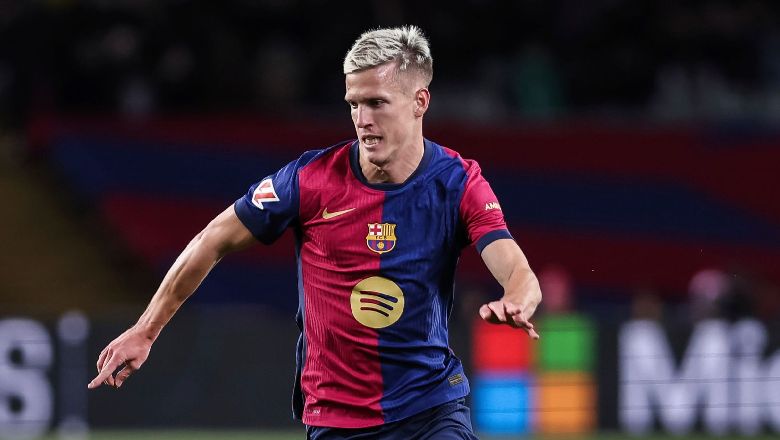
Olmo has also been a vital organ in the Spanish National Team's engine room. During Euro 2024, his role was transformative. Initially a substitute for Pedri, Olmo stepped into the attacking midfield role with clinical efficiency. He finished the tournament with 3 goals and 2 assists, scoring in the quarter-final against Germany and the semi-final against France.
Experts noted that Olmo was trusted in these high-stakes moments because of his "hybrid" nature, he possesses the passing range of a midfielder and the predatory instincts of a striker.
All positions Olmo has been used throughout his career:
Secondary striker/False 9: Primarily during his youth at La Masia and occasionally under Flick to disrupt defensive lines.
Attacking midfielder (No. 10): His preferred and most effective role at Leipzig, Spain, and currently Barcelona.
Left/Right winger: Utilized extensively at Dinamo Zagreb and in his early years at Leipzig to exploit his 1v1 dribbling and crossing.
Central midfielder (Mezzala): During transition phases where he drops deep to help in the build-up.
As Spbolivescore.net has analyzed, the €60 million investment represents far more than just a squad addition. By securing Dani Olmo's position at Barcelona, the club has acquired a player who embodies the past, present, and future of their tactical philosophy. Olmo is the bridge between the traditional La Masia style and the modern, high-intensity football demanded by the current era.
For more compelling data analysis and journeys through football’s storied past, please explore our main site. In addition to our editorial content, we offer a premier experience via our agile, real-time data hubs that monitor every fixture globally. From unbiased pre-game predictions to exhaustive tactical recaps, our platform provides the multi-faceted clarity needed to truly understand the world’s most popular sport.
The Most Popular
-
 Why do goalkeepers wear different colors?
 -
 Netherlands football kit history: The 5 most iconic shirts ever made
 -
 Who scored the first goal at Old Trafford?
 -
 Who is better: Haaland or Mbappé?
 -
 All Cristiano Ronaldo's jersey numbers revealed: How CR7 was born
 -
 England national football team squad for the 2026 World Cup: Could Foden and Palmer be left out?
 -
 Why did David Beckham retire?
 -
 How much did Arsenal buy Kai Havertz?
 -
 How much did Bayern Munich pay for Harry Kane?
 -
 How much did Man United pay for Ronaldo?